
A corridor, not a county
A project would pick a stretch of road or a neighborhood, design it, build it, and learn from it before choosing the next one.
Walton County, Florida
Exploring a practical, phased approach to moving overhead utilities underground — one corridor and community at a time.
An independent civic explainer. Not a county project, not a utility project, and not a decision to take poles down this year.
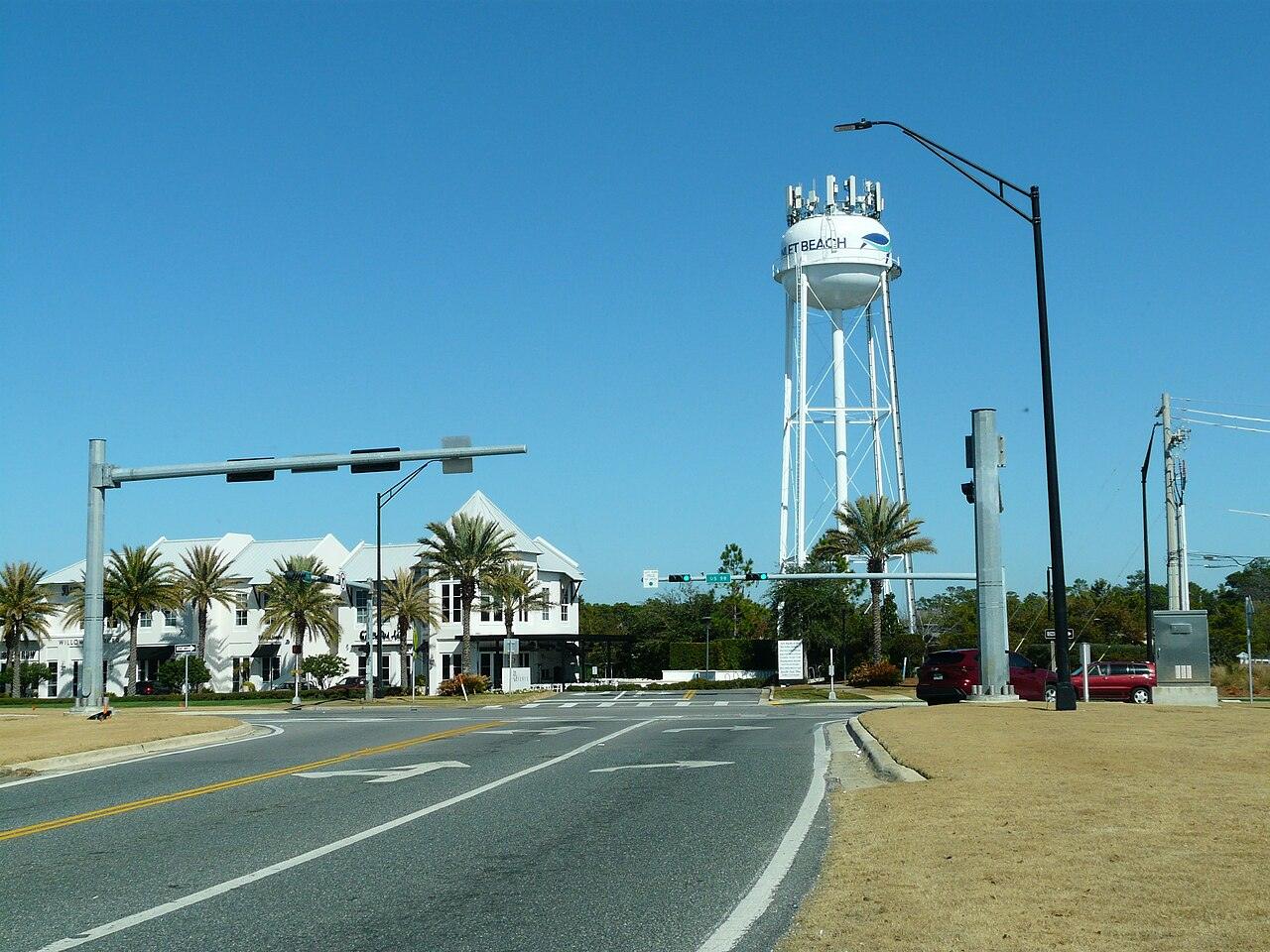
County Road 30A at U.S. 98, Inlet Beach. Photo by The Bushranger, CC BY-SA 4.0, via Wikimedia Commons. Resized for the web.
Along Scenic Highway 30A and through Miramar Beach, overhead lines are part of everyday life. They feed homes and businesses. They also sit in the wind, next to trees, and across a coast that sees hurricanes.
When limbs or poles come down, the lights go out. Crews then have to clear the road before they can rebuild the line. That is a practical problem, not a slogan. Moving wires underground, where it makes sense, is one long-term way to reduce that kind of damage.
It is not the only tool. Stronger poles, careful tree trimming, and flood-ready equipment matter too. Undergrounding is the piece this site is here to explain.
Phased means one corridor, then the next. It does not mean digging up the whole county at once, and it does not mean every pole disappears next season.
A project would pick a stretch of road or a neighborhood, design it, build it, and learn from it before choosing the next one.
Design, permits, easements, and construction take time. Other Florida communities have worked this way for years. See the examples.
Work happens in sections. Some pavement opens. Some cable is bored under driveways. Power equipment still sits above ground in boxes.
Wind and falling limbs are a leading reason overhead lines fail in a storm. Wires in conduit are out of that path. They can still fail for other reasons.
30A is a shared main street for residents and visitors. Fewer poles and crossing wires would change how the corridor looks. The green boxes that replace some poles would remain.
Poles near the travel lane are something a car can hit. Downed lines on a road are something a driver and a repair crew both have to deal with.
If a road, sidewalk, or drainage project is already opening the ground, that can be a sensible time to lay conduit, so the street is not dug twice.
A utility, the county, and the other companies on the poles would have to plan the corridor together. Surveyors mark where conduit can go. Crews install it in sections, often by boring under driveways rather than opening every yard. Homes are switched from the overhead wire to the new underground service. Only then can poles come down — and only if cable and phone have moved too.
Pad-mounted transformers stay. They are the boxes on a small concrete pad. Undergrounding hides the wires. It does not make the electric system invisible.
This site suggests Scenic Highway 30A and Miramar Beach as the first corridors to study. They are coastal, busy, and lined in places with overhead utilities. They are not a plan the county has adopted. A study could also look at evacuation routes, other scenic roads, places with repeated outages, and streets already scheduled for road work.
Walton County is not served by one electric company. Any real project has to start by mapping who owns the poles on a given block. Your power bill is the simplest clue for your own address.
This site does not publish a budget for Walton County. No mile of 30A has been priced here. Undergrounding costs more than leaving lines overhead, and the bill depends on soil, how many homes are served, and whether cable and phone move at the same time.
Florida already has more than one way to pay. On Florida Power & Light’s system, a storm program approved by state regulators can spread the cost of selected neighborhood projects across FPL customers. A city or community that simply asks for its own conversion pays the extra cost itself. Those are different paths. Walton would have to choose, with the utility that actually owns the lines.
Florida Power & Light replaces selected overhead neighborhood lines under a program in its state-approved storm plan. The Town of Palm Beach has been burying utilities phase by phase for years, with road work mixed in. Neither example is a promise that Walton can copy the price or the schedule.
If you live, work, or own property in Walton County, you can send a short note of interest. One option is to say you would support a feasibility study. That is not a vote, a petition to the commission, or a pledge of money.